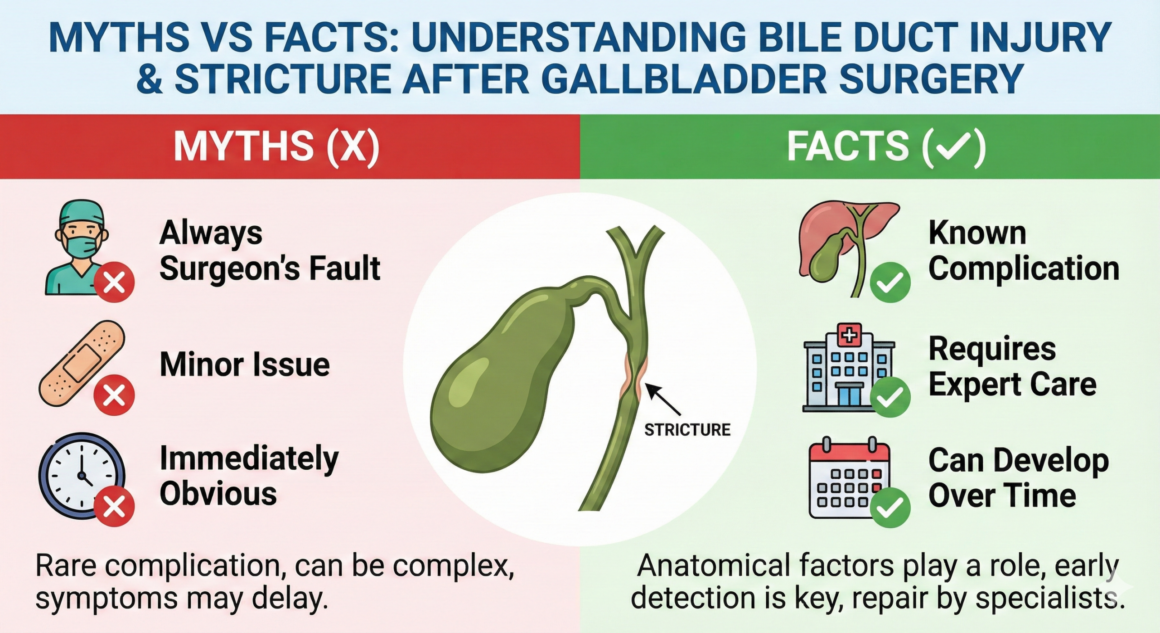
Gallbladder removal (cholecystectomy) is one of the most common abdominal surgeries performed worldwide. While the procedure is usually safe, one complication that creates fear and confusion among patients is bile duct injury (BDI) and bile duct strictures.
Unfortunately, misinformation can lead to unnecessary anxiety and delays in seeking proper care.
So, let’s separate myths from facts to help you make informed decisions.
🚫 Myth 1: Bile duct injury happens because the surgeon is inexperienced.
✅ Fact:
BDI can occur even in experienced hands. The bile duct has anatomical variations, inflammation, scarring, and distorted anatomy especially during difficult gallbladder surgeries.
Even globally, the incidence is about 0.3–0.7%, regardless of surgeon skill.
👉 It’s a known risk, not negligence.
🚫 Myth 2: If bile duct injury happens, the patient will become permanently disabled.
✅ Fact:
With modern treatment, especially expert surgical reconstruction (e.g., Hepaticojejunostomy), most patients recover well and lead normal lives.
Early diagnosis and referral to a HPB (Hepato-Pancreato-Biliary) specialist improves long-term outcomes.
🚫 Myth 3: A bile duct stricture will heal on its own.
✅ Fact:
A stricture rarely resolves naturally. Instead, it may worsen over time and lead to:
- Repeated jaundice
- Fever and chills
- Recurrent cholangitis (infection)
- Secondary biliary cirrhosis
- Liver damage
Proper intervention — endoscopic or surgical — is usually required.
🚫 Myth 4: Once a stent is placed, no further treatment is needed.
✅ Fact:
Stents are often temporary solutions, used to treat infection or drain bile before definitive reconstruction.
Leaving a stent for too long may cause:
- Stone formation
- Blockage
- Infection
Periodic removal or planned surgery is usually necessary.
🚫 Myth 5: Surgery after bile duct injury is risky and should be avoided.
✅ Fact:
Definitive surgical repair performed by a GI/HPB surgeon is often the best long-term treatment.
Modern minimally invasive or open approaches can restore normal bile flow and prevent complications like cirrhosis.
🚫 Myth 6: If symptoms settle after initial drainage, everything is fixed.
✅ Fact:
Temporary improvement does not mean cure. The underlying problem, obstruction or scarring remains and can flare up later.
Regular follow-up and imaging are essential.
🚫 Myth 7: Bile duct injuries only happen during open surgery.
✅ Fact:
They can happen during open, laparoscopic, or robotic surgery, although risk is slightly higher during laparoscopic procedures due to limited depth perception and anatomical variations.
Final Message: Knowledge Protects Your Health
A bile duct injury or stricture is not the end—it’s a condition that can be diagnosed, repaired, and managed successfully with the right care.