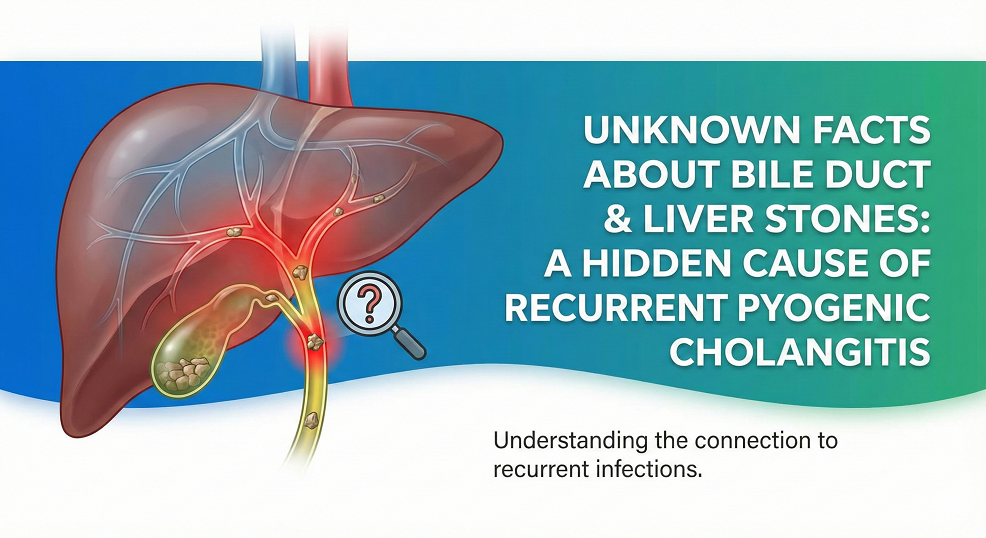
Most people know about gallstones but fewer people realize that stones can also form in the bile ducts and inside the liver, silently causing infections and long-term liver damage. One of the serious complications linked to these stones is Recurrent Pyogenic Cholangitis (RPC) a condition where repeated infections occur in the bile ducts due to obstruction and inflammation.
What Are Bile Duct and Liver Stones?
Unlike common gallstones that form in the gallbladder, these stones develop:
- In the common bile duct
- In the intrahepatic (inside liver) ducts
These stones are usually made of pigment and calcium, and are often associated with infection or chronic inflammation.
Why Are They Dangerous?
Bile duct and liver stones can block the flow of bile a digestive fluid that helps absorb fats and remove toxins. When the ducts become blocked, bacteria multiply, leading to recurrent infections.
Over time, this results in:
- Repeated high fever with chills
- Severe abdominal pain
- Jaundice
- Liver damage
- Sepsis (life-threatening infection)
What Is Recurrent Pyogenic Cholangitis?
Recurrent Pyogenic Cholangitis (RPC) is a chronic condition where the bile ducts repeatedly become infected due to stones, strictures (narrowing), or poor drainage.
Patients often experience:
- Sudden episodes of high fever with shaking chills
- Recurrent jaundice
- Abdominal pain
- Fatigue
- Loss of appetite
These episodes may temporarily improve with antibiotics but return when the blockage remains untreated.
🧬 Unknown Facts the Public Should Know
1. It Can Happen Even Without Gallbladder Stones
2. It Can Cause Permanent Liver Damage
Repeated inflammation can lead to:
- Bile duct scarring
- Liver fibrosis
- Segmental atrophy
In advanced cases, part of the liver may become dysfunctional.
3. It Can Increase the Risk of Bile Duct Cancer: Chronic irritation and infection may raise the risk of cholangiocarcinoma.
4. Symptom-Free Periods Can Be Misleading: Many patients feel better after antibiotics, but the stones remain leading to relapse.
How Is It Diagnosed?
Doctors may use:
- Ultrasound
- CT scan
- MRCP
- ERCP
- Liver function tests
🔧 Treatment Options
Treatment focuses on clearing the stones, improving bile flow, and preventing recurrence.
Options include:
- Endoscopic stone removal (ERCP)
- Balloon dilation of narrowed ducts
- Lithotripsy (breaking stones)
- Surgery for complex or recurrent cases
- Partial liver resection if a segment is repeatedly affected
With advancements, laparoscopic and robotic surgery are now used in selected cases, as Dr Saha had performed laparoscopic Roux-en-Y hepaticojejunostomy for the first time in West Bengal.
Can It Be Prevented?
While not always avoidable, steps can reduce risk:
- Avoid fatty and oily foods during flare-ups
- Stay hydrated
- Get regular follow-up imaging if diagnosed with RPC
- Early removal of bile duct stones
Key Takeaway
Bile duct and liver stones are more than just a discomfort — they can cause repeated infections, liver damage, and even increase cancer risk if untreated.
If you or someone you know has recurrent fever, jaundice, or abdominal pain — don’t ignore it. A timely evaluation may prevent long-term complications.